
There are many times in life where we come across a word or phrase that we dont know what it means. There are a couple of things you can do in these regular situations.
Nod your head and go "yup."
Look confused and say "sounds about right"
Ask clarifying questions to get more understanding
Look it up.
Far too often most of us only do the first two, when in reality we should do the last two. When I come across something I dont understand first I determine how important it is for me to understand it. If it is just shooting the breeze with friends doesnt matter too much, if it is a critical business meeting that could make or break the company, I ask all the questions to understand what is being said.
Context
Many times the context of what is being said can shed some light on what you might not understand. An example could be, you and another person are outside in the morning and the other person looks up to the sky and says "looks like it will be a scorcher today." When you look at the sky you dont see a cloud in the sky and it is already warm first thing in the morning. Just from this little context "scorcher" could mean (and does) it is going to be really hot.
Sometimes environmental context might not be enough. You and a friend are coming up with ideas for a new business idea. Your friend turns to you after you share a great idea and says, "that dog can hunt!" What does hunting and your idea have to do with each other. This is a great time to ask "what does that mean?" (or since it is a friend you are with "what the crap does that mean?!?!?") This is where they will either give you a history lesson or just tell you what it means. The simple meaning is "that is a good idea," but the history lesson part is... dogs are commonly used to help on hunting trips. But not all dogs are good at it or have even been trained to hunt effectively. When you say "that dog can hunt" it is basically stating that the dog (the subject of the conversation) is qualified enough to be a viable option verses options that would just run around in circles with little to gain.
Understanding the parts of the word or phrase
Many times you can break a word or phrase into it parts to understand what is going on. In this weeks podcast about disappointment, we show interesting insights on how this can help. When you have disappoint, you break it into the parts "dis" and "appoint." If you know what these words or parts mean you can quickly put together the meaning of the word.
An example for a phrase could be, "We're off like a herd of turtles." I would break this down into three parts "We're off," "herd of turtles," "like a." Yes, I rearranged the sentence but it is how I break the sentence down. The first part "We're off" is short for "we are off" which basically conveys that we have left ("off" in this context means departed, separated), "herd of turtles" is a group of turtles, turtles are slow creatures and culturally we have made turtles the symbol of slowness. When we put turtles and the first part together of leaving or departing it illustrates the fact that turtles move slowly. And the interesting part is "like a" indicates the comparison between the two other parts. So translating the phrase it could mean, "we are leaving really slowly," "We are not in a rush." And if you add some context if someone said this phrase with distain, or frustration it would mean something similar but still different "we are taking forever to leave," "please hurry up" (passive aggressively).
Learn the History
Many of the phrases we have (at least in English) come from some kind of history context. When you know the history of a word sometimes you get the understanding of the deeper meaning. One example is a log, think log book, or journal. Why is a journal known as a log? Arent logs something from a tree? could this be slang for paper?
The history behind a log or log book is from sailing ships. To keep track of speed and direction of travel, captains or navigators would drop a log (a piece of wood) in the water and start to measure time. These logs would have a rope tied to them and they would count the number of knots in the rope that have passed (left) the ship in a given time. This is how they would measure the speed of the ship (knots, the speed measurement) and they would then write down this information in the log book (the book used to keep track of the uses of the log (the piece of wood they put in the water)). We later shortened this to log and the concept of keeping track of events in relation to something is now known as a log. You may be asked to get the log from the computer.
Some other phrases that come from historical context are:
The whole nine yards (machine gun ammo belts were 9 yards, this is not related to American football)
Learning the ropes (another one related to running a ship, ropes control the sails)
Hail Marry (originally a prayer in Catholicism, and later made a prayer for the success of something that has little hope to work)
Struck out (originally from baseball where after three tries the player looses their opportunity to continue in the game)
Hang up (old phones when you disconnect the call, you would put the speaker part of the phone on a hook where it would hang)
Bless You (originally a blessing "God Bless You" in regards to improved blessings of health and prosperity)
Ask the internet (look it up)
Many times we can look up the meaning or phrase on the internet and go through almost the same process as above of understanding the context and how the word or phrase breaks up. A lot of the LLM's (AI's) have gotten quite good at giving meaning to even the most meaningless phrases. You can make up a phrase and put it in and these tools can give meaning to what was a useless phrase. With this they can take some of the most abstract phrases, us humans have come up with, and make sense out of it.
How ever you go about learning what things mean, there will always be new phrases or word to learn. They key is learning the correct meaning and use of words or phrases. As you master this ability you will have the power of words and phrases on your side to inspire awe when you use works correctly.
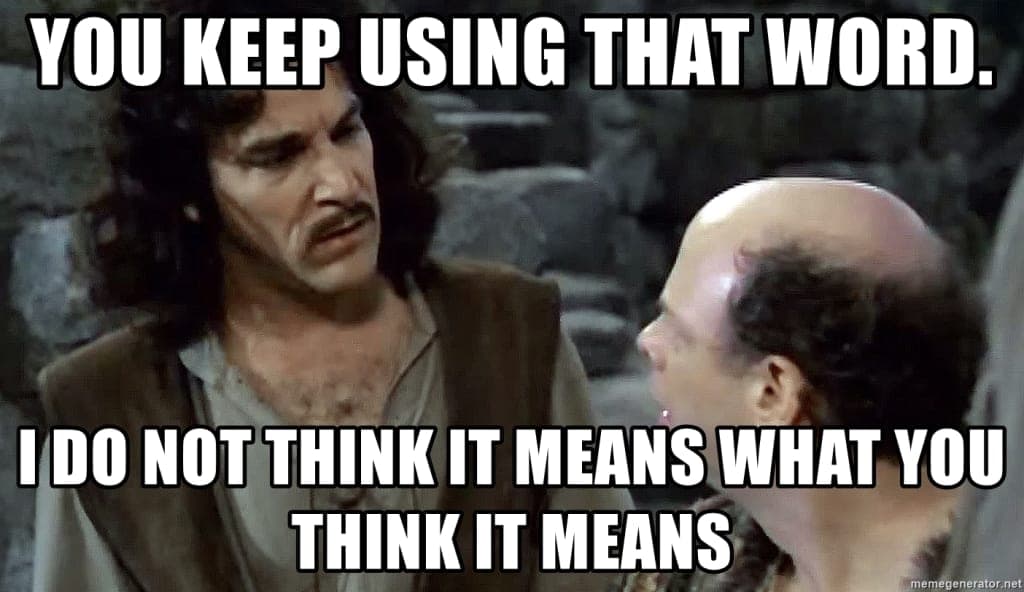
Image Credit: Princess Bride